How to Stop Your Dog Pulling on the Leash
A dog that drags you down the street turns the daily walk into a chore — and tugs at your shoulder for good measure. The good news: loose-leash walking is a trainable skill, not a personality trait, and you can teach it without a single jerk on the lead. This is a force-free plan that works with your dog's instincts instead of against them.
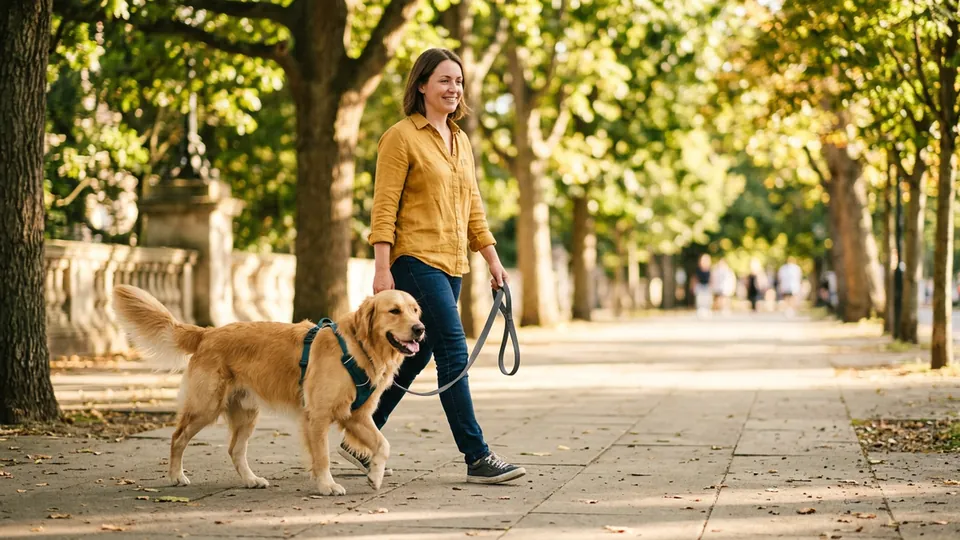
Why Dogs Pull (Hint: It Works)
Before you fix pulling, it helps to understand it. Dogs don't pull to dominate you or to be difficult — they pull because, from their point of view, it pays off. The world ahead is full of fascinating smells, other dogs and interesting corners, and pulling is the fastest way to get there.
There's a simple loop at work: your dog leans into the lead, the walk keeps moving forward, and the exciting thing gets closer. Every step you take while the lead is tight teaches your dog that tension is what makes progress happen. Add in the fact that dogs naturally walk faster than we do, and pulling becomes the default.
There's also a physical quirk called the opposition reflex: when a dog feels steady pressure against their body, the instinct is to push back against it. That's why yanking the lead tends to make pulling worse, not better. Your whole plan, then, is to flip the maths — so that a slack lead is what earns forward movement and a tight one earns nothing.
Get the Equipment Right
You can't out-train painful equipment, and you don't need to. A few humane choices make the training far easier:
- A well-fitted harness. A comfortable harness spreads any pressure across the chest instead of the throat. A front-clip design, where the lead attaches at the chest, gently turns your dog back toward you when they pull, taking the power out of it. Treat it as humane management while you train, not a magic fix.
- A fixed lead of about 1.5–2 metres. Long enough for a relaxed walk, short enough to stay in control. Skip the retractable lead for training — it only pays out when your dog pulls, so it teaches constant tension.
- High-value treats you can deliver fast, plus a marker (a clicker or a crisp word) to pinpoint the exact moment the lead goes slack.
What to avoid: choke chains, prong collars and slip leads. They work by causing discomfort or pain, they can damage a dog's neck, and they often backfire — your dog learns to associate the very things they're excited about (other dogs, the park) with a nasty sensation. That's how you accidentally create a reactive dog.
Tip: Fit-check the harness with two fingers — you should be able to slide two flat fingers under any strap, and your dog's front legs should move freely. A harness that rubs the armpits or pins the shoulders will make walks worse, not better.
Technique 1: Be a Tree
This is the foundation, and it's almost embarrassingly simple: pulling makes the walk stop; a slack lead makes it continue. The moment the lead goes tight, you stop dead and stand still, like a tree. You don't yank, scold or reel your dog in — you just become boring and immovable.
Your dog will eventually ease the tension — turning to look at you, taking a step back, or just shifting their weight. The instant the lead softens, you say "yes" (or click) and walk on. Forward motion is the reward your dog wanted all along, and now they only get it for a loose lead.
Consistency is everything here. If you stop nine times out of ten but let one good hard pull drag you forward, you've taught your dog that pulling sometimes works — and "sometimes" is enough to keep a habit alive. Decide that a tight lead never moves you, and hold that line on every walk.
Technique 2: Reward the Position
"Be a tree" tells your dog what doesn't work. This technique tells them what does. Any time your dog is walking near your side with a slack lead, mark it and treat — delivered at your leg, right where you want your dog to be.
- Start walking. The instant your dog is beside you with a loose lead, mark ("yes" or click) and feed a treat at your trouser seam.
- Take a few more steps. Mark and treat again for the slack lead.
- Keep the rate of reinforcement high at first — a treat every few steps — so staying close pays better than charging ahead.
- As your dog gets the idea, gradually stretch the gap between treats so you're rewarding longer stretches of nice walking.
The combination is what makes it click: pulling earns a dull stop, while staying close earns a steady stream of good things. Your dog does the maths quickly and starts choosing your side on purpose. That's loose-leash walking — and a tidy, focused version of it is exactly what people mean by "heel".
Technique 3: The 180 Turn
Some dogs are so keen that "be a tree" alone isn't enough — they'll strain ahead the moment you set off again. When pulling persists, add a calm change of direction.
As your dog pulls toward something, quietly turn and walk the other way. No jerk, no telling-off — just a smooth about-turn so you're no longer following the pull. Your dog has to catch up and reorient to you, and the lesson lands: pulling doesn't get me where I want to go; checking in with my human does. Mark and reward the moment your dog falls back in beside you.
Loose-Leash Walking, Step by Step
PupPlan's Leash Walking course breaks this whole plan into short, structured lessons, with a built-in clicker for marking the exact moment the lead goes slack. And with GPS walk tracking — distance, pace and route history — you can watch your walks get calmer and further over time as the training takes hold.


Make Sniffing a Reward
Here's a shift that changes everything: the walk isn't just exercise for your dog — it's for their nose. Sniffing is how dogs read the world, and it's deeply satisfying for them. Used well, it becomes one of the most powerful rewards you have.
Pick a cue like "go sniff", and use it to release your dog to investigate a lamppost or hedge after a stretch of nice loose-leash walking. Now the very thing your dog was pulling toward becomes the payoff for not pulling. You're not denying the sniffs; you're putting them on your terms — which keeps your dog motivated and the walk enjoyable for both of you.
Tip: Build in deliberate "sniffari" time on every walk — a stretch where your dog gets to potter and sniff freely. A dog whose nose is satisfied is calmer, more biddable, and far less likely to drag you toward the next interesting thing.
Build for the Real World
Dogs don't generalise well, so a behaviour learned in your quiet hallway won't automatically survive a busy pavement. Build up gradually:
- Start somewhere boring. Practise loose-leash walking in your garden or a quiet room first, where there's little competition for your dog's attention.
- Add distractions slowly. Move to a calm street, then a busier one, then somewhere with dogs and people at a distance. If your dog can't cope, you've gone too far too fast — drop back a step.
- Keep early sessions short. Five focused minutes beats a frustrating half-hour. End while your dog is still succeeding.
One honest truth: not every outing has to be a training walk. If your dog needs a proper leg-stretch and you don't have the patience to stop every two metres, pop on a front-clip harness, accept a bit of pulling, and let it be a relaxed "sniffari". Just keep your dedicated training walks separate and consistent, so you're never undoing your own work without realising it.
Troubleshooting
If your dog walks beautifully until a specific trigger appears — usually another dog, sometimes cyclists or cats — and then explodes into lunging and pulling, you're likely dealing with something other than plain manners. That pattern points to reactivity or over-arousal, which is an emotional response, not a training gap. Loose-leash technique alone won't resolve it because the dog isn't really thinking in that moment.
For that, you need to work on how your dog feels about the trigger, at a distance they can handle, using desensitisation and counter-conditioning. Our companion guide on helping a leash-reactive dog walks through exactly that.
Common Mistakes
- Being inconsistent. Letting one good pull drag you forward teaches your dog that pulling sometimes works — and that keeps the habit alive.
- Yanking the lead. Corrections trigger the opposition reflex and make pulling worse; they can also frighten your dog and create reactivity.
- Treats too slow or too low-value. If staying by your side doesn't pay better than the environment, your dog will choose the environment.
- Going too fast, too soon. Practising on a busy high street before the behaviour is solid sets your dog up to fail.
- Never letting your dog sniff. A walk with no sniffing is frustrating for a dog, and a frustrated dog pulls more, not less.
- Treating reactivity as a manners problem. If your dog only pulls toward specific triggers, address the emotion first.
Frequently Asked Questions
What's the best no-pull harness?
The best harness is one that fits well and doesn't restrict the shoulders — fit matters more than the brand. A front-clip design can take the power out of pulling and makes a handy management tool while you train, but no harness teaches loose-leash walking on its own. Always pair it with rewarding the behaviour you want.
Are retractable leads bad?
Not for everything, but they're poor for training loose-leash walking, because they only extend when your dog pulls — quietly rewarding constant tension. They're fine for safe sniffing and exploring in open spaces once walking is solid; keep a plain fixed lead for the training itself.
How long does it take to stop a dog pulling?
It depends on your consistency and how long the habit has been rehearsed. A young puppy can learn in a couple of weeks; an adult who has pulled successfully for years takes longer. Short, consistent daily practice beats occasional marathon sessions.
My dog only pulls toward other dogs — what's going on?
That pattern usually points to reactivity or over-arousal rather than plain manners, so loose-leash technique alone won't fix it. You'll need to change how your dog feels about the trigger — see our leash reactivity guide.