How to Teach "Leave It" and "Drop It"
Two short cues do more to keep a dog safe than almost anything else you'll teach: "leave it" (don't touch that) and "drop it" (give that to me). Taught well, they're force-free, fast, and built on trust — your dog gives things up willingly because doing so always pays. Here's how to build both, the kind way, so you never have to wrestle anything out of your dog's mouth again.
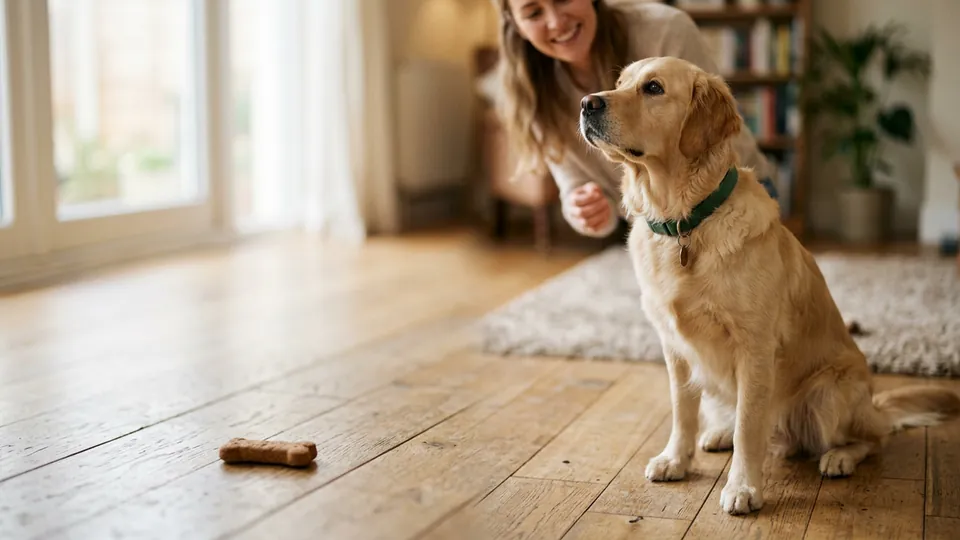
Why These Two Cues Could Save Your Dog's Life
Dogs explore the world with their mouths, and the world is full of things that can hurt them: a dropped paracetamol or blood-pressure pill, a chicken bone that can splinter, a cooked corn cob, raisins, chocolate, slug pellets, a discarded vape. By the time you've spotted the danger, you usually have a second or two to act — and in that moment, you need your dog to listen.
The two cues split that job cleanly. "Leave it" is preventative: it tells your dog to turn away from something before it goes in the mouth. "Drop it" is the backup: it tells your dog to release something that's already in there. Together they cover both halves of every "oh no, don't eat that" moment, indoors and out.
The whole approach below is force-free and reward-based. That isn't just gentler — it's more reliable. A dog who has learned that giving things up earns something brilliant will give things up quickly and happily. A dog who has learned that you take things away by force will start to swallow fast, run off, or guard. We'll come back to why that matters.
Teaching "Leave It" (Step by Step)
Start somewhere quiet and boring, with your dog a little hungry and a pot of small, high-value treats to hand. The golden rule throughout: whatever you ask your dog to leave, you always pay with something better.
- The closed-fist game. Put a low-value treat in your closed fist and offer it to your dog. They'll lick, nibble, and paw at your hand — just wait. The instant they back off, even slightly, mark it (a clicker or a crisp "yes!") and reward from your other hand with a tastier treat. Never feed the treat they were pestering.
- Add the cue. Once your dog reliably turns away from your fist, start saying "leave it" calmly just before you present it. The words now predict the game.
- Open hand on the floor. Place a treat under a flat hand on the floor. Say "leave it." Mark and reward the moment your dog disengages. Slowly lift your hand so the treat is exposed but you can still cover it if needed.
- Treat on the floor, you ready to cover. Put a treat on the floor uncovered, hand hovering. Say "leave it." Reward the turn-away from your other hand. Cover the treat with your foot if your dog dives for it — no telling-off, just prevent the grab and try an easier version.
- Walk past it. Drop a treat, cue "leave it," and walk your dog past it on a loose lead, rewarding heavily for staying with you.
- Real-world items. Generalise to the things that actually matter: a tissue, a sock, food wrappers, then outdoor temptations. Each new item is a fresh start — drop your criteria and rebuild quickly.
Tip: "Leave it" should never feel like a loss to your dog. The reward you give for leaving something must be better than the thing they left — that's what makes the cue worth obeying when it really counts.
Teaching "Drop It" (the Trade Game)
"Drop it" is a trade, not a confiscation. The mechanics are simple and the mindset matters: your dog should learn that opening their mouth makes good things appear.
- Give your dog a toy or a low-value chew they'll happily hold.
- Hold a higher-value treat right to their nose. Most dogs open their mouth to take it — the toy drops.
- Mark the release ("yes!") and feed the treat.
- Add the cue: say "drop it" calmly just before you offer the trade, so the words come to mean "let go, payment's coming."
- Crucially, give the item back a good portion of the time. When dropping doesn't always mean losing the fun thing, your dog drops faster and without hesitation.
Repeat until "drop it" produces an instant, cheerful release with no treat in sight — your dog spits the item out and looks to you expectantly. That happy little reflex is exactly what you want in an emergency.
Safer Walks, Step by Step
PupPlan turns these life-saving cues into a structured plan. Work through dedicated leave-it and drop-it lessons among 21 training courses, use the built-in clicker to mark the exact moment your dog disengages, and track every real-world rep on GPS walks — all in one calm, ad-free app.


Proofing for the Real World
A cue learned in your quiet kitchen won't automatically work next to a discarded kebab on a pavement. You have to "proof" it — practise across the situations where you'll actually need it.
- Practise on walks. Set up easy wins: cue "leave it" as you pass a leaf or a stick, reward generously, and build from there.
- Increase distractions gradually. Move from boring objects to mildly interesting ones to genuinely tempting ones, one small step at a time. If your dog fails twice in a row, the step was too big.
- Keep the reward value high outdoors. Competing with real-world smells takes serious pay. Use your dog's absolute favourites — cheese, chicken, liver — when you train outside, not kibble.
- Reward checking in. Mark and treat every time your dog glances up at you unprompted on a walk. A dog who keeps an eye on you is far easier to redirect.
Why You Must Never Force the Mouth
It's tempting, in a panic, to prise your dog's jaws apart or chase them down and grab. Don't. Forcing the mouth open, peeling fingers in, or pinning your dog to extract an item teaches one lesson very clearly: humans steal valuable things, so guard them.
That's how resource guarding starts — the growling, the stiffening, the gulping things down before you can reach them. Each forced grab makes the next "drop" harder and the situation more dangerous. Trading does the opposite: it keeps the whole thing cooperative, so your dog comes to you with prizes instead of fleeing from you. The cooperative dog is the safe dog.
Tip: If your dog already growls, stiffens, or runs when you approach something they have, don't push it — work with a qualified force-free behaviourist. Guarding is fixable, but it needs a careful plan, never confrontation.
Emergency Use: When It Really Counts
However well you train, one day your dog will grab something genuinely dangerous. Here's how to handle it without making things worse:
- Stay calm. A panicked lunge tells your dog the item is precious and worth defending or swallowing fast. Keep your voice light and your body relaxed.
- Don't chase. Chasing turns it into a thrilling game and guarantees a repeat performance. If anything, move away and invite your dog to follow you.
- Trade big. Reach for the best thing you have — scatter a handful of treats on the ground, run to the fridge, grab a favourite toy. Make giving up the item the obviously better deal.
- Use your cues. A well-rehearsed "drop it" or "leave it" is your fastest tool — which is exactly why you practise them when there's no emergency.
- If it's swallowed and toxic, skip the standoff entirely and ring your vet or an animal poison line straight away. Time matters more than recovering the object.
Frequently Asked Questions
What's the difference between "leave it" and "drop it"?
"Leave it" means don't pick that up in the first place — turn away before it reaches the mouth. "Drop it" means release what's already in the mouth. You'll often use them back to back: leave it for what you spot in time, drop it for what your dog grabbed before you could.
My dog runs away when they grab something — what do I do?
Don't chase — it turns into the best game ever. Instead, trade: produce a high-value treat, scatter food away from the item, or run the other way so your dog follows you. Long term, teach a happy, well-rehearsed drop it and work on recall so coming to you always pays.
How do I stop my dog eating things on walks?
Teach a strong "leave it" and proof it outdoors with top-value rewards, reward your dog for checking in with you, and manage with a lead or long line so they can't rehearse scavenging. Run management and training side by side until leave it is solid enough to rely on alone.
Will trading teach my dog to grab things just to get treats?
Rarely, as long as you also reward your dog for leaving things and ignoring items they pass. A few dogs test it, but the safety payoff — a dog who happily gives up a chicken bone or a dropped pill — far outweighs the odd opportunistic pick-up.