Why Do Dogs Love Squeaky Toys?
One squeak and your dog materialises from the other end of the house, ears up, eyes locked on. Why does that little sound have such power — and how can you put it to work in training? Here's the science, the practical uses, and what to do if your dog loves squeaks a bit too much.
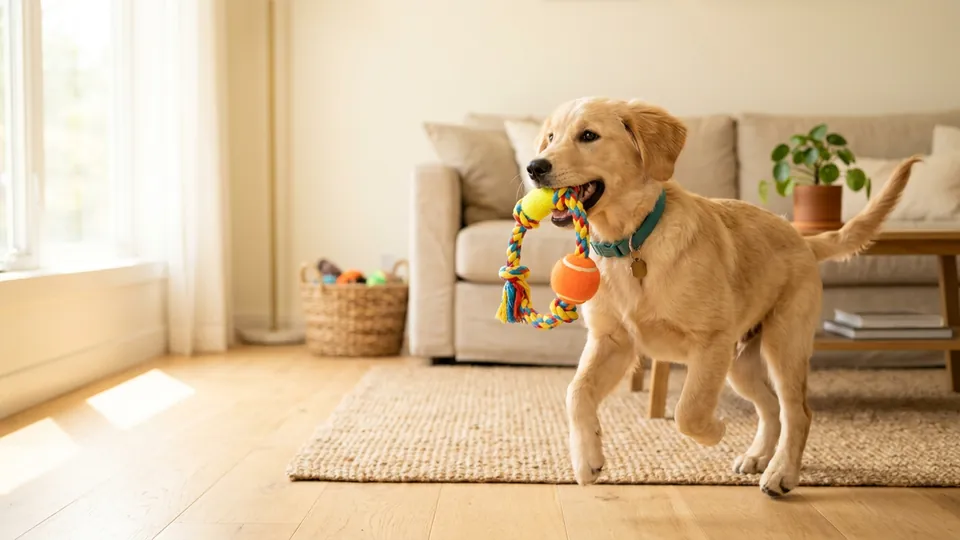
The Science: Prey Drive Meets Instant Feedback
There are two big reasons squeaky toys are irresistible to most dogs:
- The frequency. A squeaker produces a high-pitched sound in the same range as the small animals dogs' ancestors hunted. Even the most pampered couch dog still carries that wiring — the squeak flips an ancient "something interesting is happening" switch.
- The feedback loop. Bite → squeak → excitement → bite again. The toy responds instantly to your dog's action, which is exactly how animals learn. A silent toy gives nothing back; a squeaky toy "answers", and that makes it endlessly engaging.
Add novelty — squeaks are unpredictable in timing and tone — and you have the most reliable canine attention-getter ever invented. Dog trainers and pet photographers have exploited this for decades: when you see a perfectly alert dog in a photo, ears forward and head tilted, there was very often a squeaker behind the camera.
Squeaks as a Training Tool
Because a squeak grabs attention without commanding or pressuring your dog, it's a genuinely useful training aid. The key is to use it sparingly and pair it with good things, so it keeps its magic:
- Focus work — when your dog drifts off mid-session, one squeak re-engages them. Reward the moment they look at you, and you've turned distraction into a training rep.
- Recall — squeak just as your dog turns toward you and the last few metres of a recall become the most exciting part. Far kinder and more effective than repeating their name with growing frustration.
- Luring movement — a squeak can draw your dog into position for a spin, a "come around", or simply off the sofa without any physical handling.
- Photos — one squeak, one head tilt, ears up. That's the whole technique.
- Starting play — a squeak is a clear "game on!" signal for tug or fetch, which makes play itself easier to start and stop on cue.
Important distinction: a squeak gets attention; it doesn't mark behaviour. If you want to tell your dog "that exact thing you just did earned the reward", that's a job for a clicker — see our clicker training guide. The two tools are partners, not substitutes.
A Squeaker in Your Pocket
PupPlan's built-in Squeak Toy gives you one-tap squeaks with multiple realistic sound variations — latex, rubber, and chew-toy textures — so it never goes stale. It sits alongside the clicker, dog whistle, and desensitization sound library in one training toolkit.


When the Love Gets Too Intense
For some dogs, squeaks tip from joy into frantic over-arousal: fixating, vocalising, gutting every toy in minutes, ignoring everything else in the world, or guarding squeaky toys from people and other pets. A few signs your dog is over the line:
- They can't disengage from the toy even for high-value food
- Play turns frantic rather than bouncy and loose
- They react to squeaky sounds from the TV, other dogs' toys, or a child's toy across the park
- Stiffening, freezing, or snapping when someone approaches "their" squeaky
The fix isn't banning squeaky toys forever — it's teaching your dog to hear squeaks while staying thinking. That's a desensitization job:
- Start with recorded squeaks at very low volume — quiet enough that your dog notices but stays relaxed.
- Reward calm. Squeak sound → treat for staying settled. You're paying for composure, not excitement.
- Raise the volume gradually over many short sessions (5–10 minutes), only stepping up when your dog has been consistently calm at the current level.
- Reintroduce real toys with rules — structured tug or fetch with clear start and end cues, and trades for treats rather than chase-and-grab endings.
It's the same gradual, sub-threshold protocol used for fireworks and thunder fears — the trigger just happens to be a happy one. Our fireworks desensitization guide explains thresholds and session structure in depth; everything there applies to squeaks too.
A Word on Safety
Squeakers are small plastic parts, and determined dogs can extract them with surgical precision. Supervise play with destructible toys, take damaged toys away, and call your vet if a squeaker goes missing in suspicious circumstances — swallowed squeakers can cause intestinal blockage. (One more advantage of a squeak from your phone: there's nothing to swallow.)
Frequently Asked Questions
Why does my dog go crazy when a toy squeaks?
The squeak's frequency matches small-prey sounds and the instant bite→squeak feedback loop taps straight into your dog's prey-play wiring. It's normal, healthy excitement for most dogs.
Is it bad to let my dog play with squeaky toys?
No — it's great enrichment. Just supervise toy-destroyers (squeakers are a swallowing hazard) and watch for obsession or guarding, which call for structured play and desensitization.
How do I calm a squeak-obsessed dog?
Gradual desensitization: quiet recorded squeaks, reward calm, raise volume slowly over weeks. Teach structured games with start/stop cues for real toys.
Do all dogs like squeaky toys?
Most do, but not all — some dogs are indifferent and a few find squeaks unsettling. If your dog startles or avoids squeaks, skip them or use the same low-volume desensitization approach to build comfort.