10 Easy Dog Tricks to Teach (Step by Step)
Tricks aren't just for show — they build focus, confidence and a closer bond, and they're brilliant fun for both of you. Every trick below is taught the kind way: luring, capturing and shaping with a marker, never force. Grab some treats and let's teach your dog something new.
Before You Start
A few minutes of setup makes everything that follows easier. Get these basics in place and your dog will learn faster — and have more fun doing it.
- Have a marker ready. A clicker or a crisp "yes!" tells your dog the precise instant they got it right. New to this? Our clicker training guide for beginners walks you through it.
- Use tiny, high-value treats. Pea-sized and soft, so your dog can eat fast and stay keen. You'll be feeding a lot.
- Keep sessions to 3–5 minutes. Short and frequent beats long and tiring. A couple of mini-sessions a day works wonders.
- Split each trick into tiny steps. Reward the first hint of the right movement, then ask for a little more.
- End on a success. Always finish with something your dog can nail, so they leave wanting more.
Throughout, remember the golden rule: no pushing, pulling or holding your dog into position. We lure with food, capture behaviours your dog already offers, and shape them step by step. That's it.
The 10 Tricks
1. Touch (Hand Target)
The most useful trick of all — your dog learns to boop their nose to your palm. It builds focus and becomes a handy "follow my hand" cue for everything else.
- Hold your flat palm a few centimetres from your dog's nose.
- Curiosity will make them sniff it — the moment their nose touches, mark and treat.
- Repeat until they're bumping your hand eagerly, then add the cue "touch" just before you present your palm.
- Move your hand to different spots so they have to come and find it.
2. Shake / Paw
A classic greeting. Most dogs paw at things naturally, which makes this an easy capture.
- Hold a treat in a loose fist near your dog's chest, low down.
- Wait. When they paw at your hand to get the treat, mark and reward.
- Once they're reliably pawing, open an empty hand and offer it as the target.
- Add the cue "shake" and reward the paw landing in your palm.
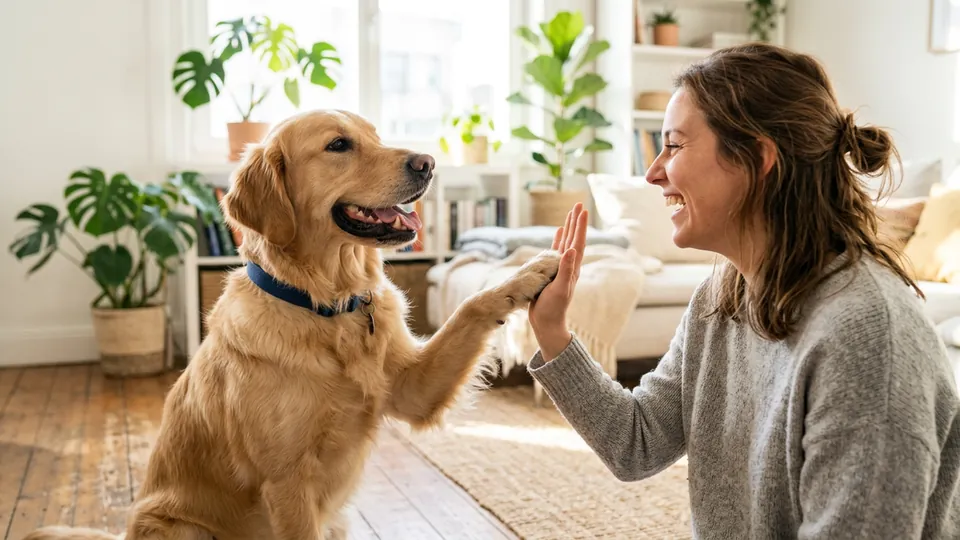
3. High Five
Once shake is solid, high five is a quick spin-off your dog will love.
- Ask for a "shake", but hold your hand a touch higher and more upright.
- As your dog lifts their paw higher to reach it, mark and treat.
- Gradually raise your hand until the paw meets your palm at a fun "five" height.
- Add a new cue — "high five!" — and keep it bright and playful.
4. Spin
A flashy little trick taught entirely by luring. Teach it in both directions to keep your dog balanced.
- Hold a treat at nose level and slowly draw a circle, leading your dog's nose around.
- Mark and treat the moment they complete the turn.
- Make your hand movement smaller each time until it's a small flourish.
- Add the cue "spin" one way and "twist" the other.
5. Sit Pretty / Beg
Your dog sits up on their haunches with front paws tucked. It's adorable — and a gentle core workout.
- Start with your dog in a sit.
- Hold a treat just above their nose and lift it slowly so they reach up.
- Mark and treat the instant their front paws leave the floor — even a little.
- Build up the duration and height gradually, then add the cue "sit pretty".
Tip: Sit pretty asks a lot of the back and core, so keep reps low and build slowly. Skip it for very young puppies, senior dogs, or long-backed breeds prone to back trouble — there are nine other tricks here to enjoy instead.
6. Bow
Front end down, back end up — the classic play-bow, on cue. Lovely to watch and a nice stretch.
- With your dog standing, lower a treat from their nose straight down to between their front paws.
- As their elbows drop toward the floor (back end still up), mark and treat.
- If they lie all the way down, make the next lure smaller and reward earlier.
- Once the shape is clean, add the cue "bow".
7. Roll Over
A crowd-pleaser built one slice at a time. Use a soft surface so your dog is comfortable.
- Start in a down. Lure a treat from your dog's nose toward their shoulder so they look back.
- Continue the arc over their spine — they'll flop onto their side. Mark and treat.
- Next, carry the lure all the way over so they roll onto their back and round to the other side.
- Mark the full roll, then shrink the lure and add the cue "roll over".
8. Speak (on Cue)
Teaching a barking cue gives you control — and lets you teach "quiet" as the natural opposite.
- Find what makes your dog bark (a doorbell, a held-back toy) and have treats ready.
- The instant they bark, mark and treat.
- Once they bark on purpose to earn the reward, add the cue "speak" just before they do.
- Then teach "quiet": cue speak, wait for a pause, and mark the silence — building calm right alongside the noise.
9. Leg Weaves
Your dog figure-eights between your legs as you step. Fun, fitness-friendly, and a real focus-builder.
- Take a wide step forward and lure a treat through the gap from front to back.
- Mark and treat once they're through.
- Step with the other leg and lure them back through the new gap.
- Link two passes, then more, fading the lure into a small hand signal and adding the cue "weave".
10. Wave
A charming sign-off that grows straight out of your shake.
- Ask for a "shake", but pull your hand away just before the paw lands.
- As your dog's paw lifts and paddles at the air, mark and treat.
- Repeat until the lifted-paw motion looks like a wave, hand further back each time.
- Add the cue "wave" and a friendly wave of your own hand as the signal.
Level Up Trick Training
PupPlan turns trick practice into a game. Follow the structured Trick Training course (one of 21 in the app), mark every win with the built-in clicker, and earn XP and trick milestone achievements as your dog levels up in the Training Journey — daily streaks included.


Tips for Faster Learning
A handful of habits will help every trick come together more quickly — and keep both of you enjoying the process.
- Shape, don't wait for perfection. Reward the first rough version, then nudge it closer to the finished trick over many small reps.
- Raise your criteria slowly. If your dog fails twice in a row, the step was too big — make it easier and rebuild from a win.
- Fade the lure early. Once your dog follows the food reliably, mimic the same motion with an empty hand so it becomes a real cue.
- Keep it light. Use a happy voice, celebrate small wins, and stop while your dog still wants more.
- Practise tricks anywhere. Tricks build focus and confidence, so a quick spin or touch is a brilliant way to settle a nervous dog or refocus a distracted one.
Frequently Asked Questions
What age can I start teaching tricks?
Any age. Puppies can start as soon as they're home — just keep sessions very short and the steps tiny. Adult and senior dogs learn tricks beautifully too, often faster than puppies thanks to longer attention spans. It really is never too late to teach an old dog new tricks.
How long does it take to teach a trick?
It varies. Simple tricks like touch or shake can click in a single session, while roll over or leg weaves usually come together over several days. Consistency matters more than marathon sessions — a few minutes a day, every day, beats one long weekly attempt.
Do I need a clicker to teach tricks?
No. A clear marker word like "yes!" works perfectly well — what matters is marking the exact moment your dog does the right thing. A clicker simply sharpens your timing because the sound is short and identical every time. Use whichever you'll be most consistent with.
My dog loses interest quickly — what should I do?
Shorten your sessions, use higher-value treats, and break the trick into easier steps so your dog wins more often. Always stop while your dog still wants more, ending on a behaviour they can do easily. Frequent little wins keep enthusiasm high.