How to Stop Your Dog Barking Too Much
Barking isn't a single problem with a single fix — it's your dog talking, and the right solution depends entirely on what they're trying to say. A dog who barks at the window needs a different plan from one who barks for your attention or one who barks from sheer boredom. Get the diagnosis right and the cure usually follows. Here's how to read the bark and quieten it for good — without shouting, and without an anti-bark collar.
First, Diagnose the Bark
Before you can reduce barking, you need to know why it's happening. Most excessive barking falls into one of these types:
- Alert / territorial — at the doorbell, the window, people or dogs passing the house or garden.
- Demand — aimed at you, to get attention, food, a toy, or to be let out.
- Boredom / under-stimulation — repetitive, often when left alone or with nothing to do.
- Fear / anxiety — at scary noises, strangers, or being left alone.
- Frustration / greeting — excited, high-pitched barking when they can't reach something they want.
Spend a few days simply noticing when, where and at what your dog barks. The pattern tells you which plan below to follow. Trying to "train away" barking without knowing the cause is how people end up frustrated — and how dogs end up punished for something they can't help.
Tip: Never shout at a barking dog. To your dog, your raised voice sounds like you joining in — it can actually reinforce the very thing you're trying to stop.
Alert Barking at the Door, Window and Garden
Alert barking is self-rewarding: your dog barks, the postman leaves, and from your dog's point of view the barking "worked". The fix is part management, part training.
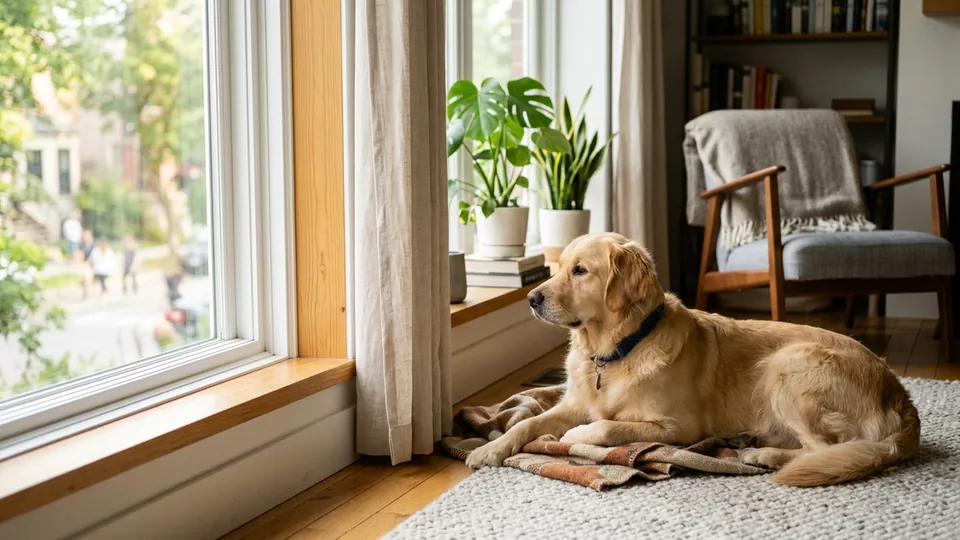
- Reduce the trigger. Close blinds, apply window film to the bottom half of the glass, or move the dog's bed away from the front window so passers-by stop setting them off.
- Acknowledge, then redirect. A few barks at a knock are reasonable. Calmly say "thank you", then ask for an alternative behaviour — sending your dog to a mat or bed for a reward gives them a job instead of a bark.
- Desensitise the doorbell. Play a recorded doorbell at a low volume and feed treats, raising the volume over many short sessions until the sound predicts "go to your mat" rather than "bark your head off".
Demand Barking (The Tricky One)
Demand barking is a habit you've accidentally built together: at some point barking earned attention, a treat, or the door being opened, so your dog keeps trying it. The cure is simple to describe and hard to do consistently.
- Stop paying the bark. The instant your dog barks at you for something, calmly withdraw the reward — turn away, or briefly step out of the room. No telling-off (that's attention too).
- Reward the quiet. The moment your dog pauses, mark it ("yes!") and reward. You're teaching that quiet, not noise, opens doors.
- Pre-empt the need. Meet exercise, toilet and enrichment needs proactively so there's less to demand in the first place.
Be ready for an extinction burst: when the old strategy stops working, most dogs bark harder for a while before giving up. If you cave during the loud phase, you've taught your dog that louder works — so decide you can see it through before you start.
Quieter Days, One Step at a Time
PupPlan turns these techniques into guided, force-free courses — including Calm & Settle and Fear & Anxiety Management — plus a desensitization sound library for doorbell and knock triggers, and 15 enrichment games to tire a bored, barky brain. Free 3-day trial.


Boredom Barking
A dog with nothing to do will make their own entertainment, and barking is a popular choice. If the barking is repetitive and worst when your dog is unoccupied, the answer isn't more discipline — it's more to do.
- Add mental work, not just physical: sniffing walks, scatter feeding, chews, and puzzle or foraging games tire a dog far faster than a lap of the park.
- Feed meals from enrichment toys instead of a bowl so dinner becomes a 20-minute project.
- Build in calm, settled downtime too — an over-tired dog can become more vocal, not less.
For a stack of ideas you can set up with things you already own, see our guide to dog enrichment.
Fear and Frustration Barking
When barking comes from fear — of fireworks, strangers, or other dogs — punishing it makes the underlying emotion worse. The dog isn't being "naughty"; they're frightened. The fix is to change how they feel about the trigger using desensitisation and counter-conditioning: expose them to a mild, distant version of the scary thing while great things happen, and build up slowly.
This is exactly the approach in our guides to leash reactivity and desensitising a dog to fireworks — the same principles apply to most fear-based barking.
Teach "Quiet" the Kind Way
A clear "quiet" cue gives you a polite off-switch. Teach it with rewards, never with intimidation:
- Wait for a natural pause in barking — or capture one — and immediately mark and reward the silence.
- Some dogs learn faster if you first teach "speak" on cue; once you can ask for a bark, you can ask for it to stop and reward the gap.
- Gradually hold out for slightly longer pauses before rewarding, so "quiet" comes to mean "stay quiet", not just "stop for a split second".
Why Anti-Bark Collars Backfire
Shock, citronella-spray and ultrasonic collars are marketed as quick fixes, but they only suppress the noise — they do nothing about the reason behind it. Worse, they add pain or stress to a dog who may already be barking out of fear, which can deepen anxiety and, in some dogs, tip over into aggression. They also punish appropriate barking (a genuine alert) along with the nuisance kind. Kind, cause-based training takes a little longer, but it actually solves the problem instead of muzzling the symptom.
Common Mistakes
- Shouting "no!" — it reads as you joining the chorus and rewards the barking with attention.
- Treating every bark the same. Alert, demand, boredom and fear need different plans — diagnose first.
- Caving during the extinction burst. Giving in when demand barking gets louder teaches your dog that louder works.
- Reaching for an anti-bark collar. It suppresses the symptom and can make fear and aggression worse.
- Forgetting enrichment. Many "barky" dogs are simply under-stimulated; a tired brain is a quiet one.
Frequently Asked Questions
How do I stop my dog barking at the doorbell?
Treat it as alert barking: mute or block the trigger first, then desensitise the doorbell sound at low volume while feeding treats, and teach your dog to run to a mat for a reward instead of barking when it rings.
Why does my dog bark for attention and how do I stop it?
Because it has worked before. Calmly remove the reward the instant they bark, and reward the moment they're quiet. Expect an extinction burst — the barking often gets louder before it fades — and stay consistent through it.
Are anti-bark collars safe?
No. They suppress the symptom without addressing the cause and add stress and pain that can worsen fear and aggression. Force-free, cause-based training is both kinder and more effective.
My dog barks all day when I'm out — what does that mean?
It could be boredom or separation anxiety. Film your dog: a bored dog barks intermittently and settles between bouts, while separation anxiety shows panic. If it looks like panic, follow a gradual absence-training plan and consider professional help.