How to Stop Puppy Biting and Mouthing
Needle-sharp puppy teeth on your hands, sleeves and ankles can feel relentless — but mouthing is completely normal puppy behaviour, not aggression. With a calm, force-free plan you can teach your puppy to control their jaws and redirect those teeth onto things they're allowed to chew. Here's exactly how.
Why Puppies Bite (It's Normal)
Before you fix anything, it helps to understand why your puppy is doing it. Biting and mouthing are not signs that something is wrong — they're a developmental stage every puppy goes through. There are a few overlapping reasons:
- Teething. Between roughly three and seven months, puppies lose their milk teeth and grow 42 adult ones. Sore gums make chewing on anything — including you — feel good.
- Exploring the world. Puppies don't have hands. Their mouth is how they investigate textures, objects and the people around them.
- Play. Littermates wrestle and mouth each other constantly. When the litter leaves, you become the new playmate, and the puppy plays the only way it knows how.
- Over-tiredness. Like an overtired toddler, a puppy that has missed a nap gets cranky, frantic and far more bitey.
- Over-arousal. Too much excitement — rough games, lots of people, a long play session — tips a puppy past the point of self-control, and the teeth come out.
Recognising the cause in the moment tells you what to do. A teething puppy needs a chew; an over-tired one needs a nap, not a training session.
The Goal: Bite Inhibition First
The single most valuable thing you can teach a young puppy is bite inhibition — the ability to control how hard they bite. A dog that learned as a puppy to use a soft mouth is far safer for life, because if it ever is startled or hurt as an adult, it already knows to pull its bite.
At eight to ten weeks, your goal is not zero contact — it's teaching your puppy that human skin is astonishingly fragile. You do that by reacting to pressure: soft mouthing is tolerated for now, but the instant teeth clamp down with any real force, the fun stops. Over time you raise the bar, accepting gentler and gentler contact, until teeth on skin disappears almost entirely.
Tip: Don't rush to ban all mouthing on day one. A puppy that never gets to practise softening its bite never learns it. Teach "gentle" first, then "none."
What to Do the Moment Teeth Touch Skin
The classic advice is to "yelp like a littermate." That still works for many puppies, but the real engine is the consequence behind it: biting makes the fun stop, instantly. Here's the modern, reliable version:
- The moment teeth press into skin, mark it with a calm, neutral sound or a short word — a quiet "ow" or "oops." Keep it low-key; a dramatic shriek can excite some puppies.
- Immediately remove all the fun. Stand up, fold your arms, and look away — or step over a baby gate or out of the pen for 10–20 seconds.
- When the time is up, calmly return and re-engage. No telling-off, no fuss.
- Repeat consistently. Your puppy quickly learns that soft play continues, but teeth-on-skin ends the best thing in the room: your attention.
This is a brief withdrawal of attention, not punishment. You're simply showing your puppy the natural result of biting too hard. Never hold the mouth shut, scruff, shout at or smack a puppy for mouthing — those tactics frighten the dog, damage trust, and can make biting worse.
Redirect Onto Legal Targets
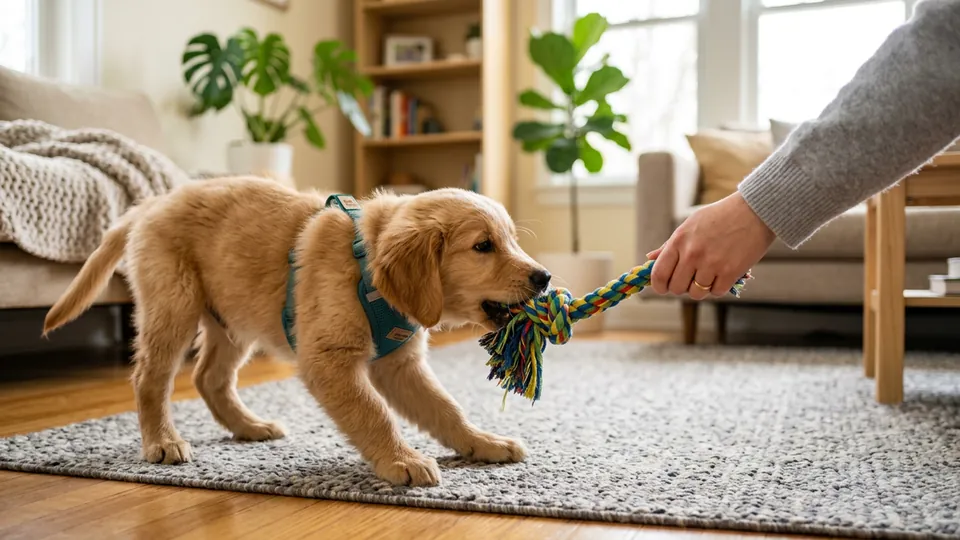
Stopping the bite is only half the job. A puppy still needs an outlet, so always have an approved chew or tug toy within reach. The principle is simple: reward chewing the toy, never your hands.
- Keep a tug or chew in your pocket so you can offer it the instant your puppy gets mouthy.
- When the puppy switches from your hand to the toy, praise warmly and keep the game going — the toy becomes the source of all the fun.
- Wiggle the toy along the floor rather than waving it near your fingers, so the puppy aims at the toy, not your hand.
- Rotate a few different textures so chewing stays interesting and your puppy doesn't drift back to clothing and skin out of boredom.
Turn the Tide on Biting
PupPlan's Stop Biting & Chewing course walks you through bite inhibition and redirection with step-by-step lessons, homework and quizzes. The built-in squeak toy gives you a quick way to redirect attention away from your hands, and 15 enrichment games help burn off the energy that fuels the witching hour — all in one app, with no ads.


Manage Arousal and the "Witching Hour"
Many owners notice a daily spike — often in the evening — when their puppy turns into a tiny crocodile, tearing around in zoomies and biting everything. This "witching hour" is almost always driven by over-tiredness and pent-up energy, not naughtiness. The fix is prevention, not correction.
- Protect naps. Young puppies need a lot of sleep — often 18 hours a day. Build in regular downtime in a pen or crate so your puppy doesn't run on empty.
- Offer a calming activity. A long-lasting chew or a sniffing game settles a wired puppy far better than another round of fetch.
- Wind down, don't wind up. In the run-up to the usual crazy hour, switch to gentle sniffing and licking activities rather than high-energy play.
- Spot the early signs. When the biting suddenly ramps up and nothing settles it, the answer is usually sleep. Pop your puppy down for a nap before it boils over.
Teach Incompatible Behaviours
A puppy can't bite your hand and do something else with its mouth at the same time. Teaching calm, incompatible behaviours gives your puppy a better way to get what it wants:
- Hand targeting. Teach your puppy to boop your flat palm with its nose for a reward. A nose-touch is the opposite of a bite, and it's a brilliant way to move a puppy around without grabbing.
- Sit for greeting. Reward a sit when people approach so the default greeting is bottom-on-floor, not teeth-on-sleeve.
- Trading. Swap a chew or treat for whatever's in the puppy's mouth, so giving things up feels rewarding rather than threatening.
A clicker makes this easy: it lets you mark the exact instant your puppy makes the calm choice. New to it? See our clicker training for beginners guide.
Special Case: Kids and Biting
Puppy teeth and children are a tricky mix — kids are fast, squeaky and at exactly the right height to be a fantastic chew toy. Management protects everyone and keeps the puppy from rehearsing the habit:
- Supervise every interaction, and use a gate or pen to give the puppy guaranteed child-free downtime.
- Ban chasing, wrestling and rough games — they wind a puppy past the point of self-control.
- Teach children to "be a tree": stand still, fold their arms, and look away. A boring, motionless person gives an excited puppy nothing to chase or nip.
- Show kids how to calmly drop a toy and step back, so they redirect the puppy instead of flapping and squealing.
Keep these interactions short and positive. The aim is for puppy and child to learn that calm equals fun.
When It's More Than Normal
The vast majority of puppy biting is ordinary mouthing that fades with the plan above. Occasionally, though, something needs a closer look. Reach out to a qualified, force-free behaviourist if you see biting paired with a stiff, frozen body, growling, hard contact in an older dog, or clear escalation rather than the usual playful nipping.
Asking for help early is never an overreaction — a good behaviourist can read the body language in person and tailor a plan. Choose someone who works only with reward-based, force-free methods.
Frequently Asked Questions
At what age do puppies stop biting?
Mouthing usually eases once the adult teeth are in and teething ends, around 6–7 months — sooner if you've been practising bite inhibition and redirection. It's a phase, but consistent training fades it faster than waiting alone.
Does yelping make biting worse?
For some puppies, yes — a high-pitched yelp can sound like a squeaky toy and excite them. If your yelp makes the biting more frantic, drop it and switch to silent withdrawal: simply stand up and remove your attention for 10–20 seconds.
Should I let my puppy bite during play at all?
Gentle mouthing is part of learning bite inhibition, so you don't need to forbid every bit of contact at eight to ten weeks. The rule that matters is the consequence: soft mouthing can continue, but the moment teeth press hard against skin, the game ends.
How do I stop my puppy biting my children?
Manage interactions: supervise closely, use a gate for downtime, and ban chasing and rough games. Teach kids to "be a tree" — stand still, arms folded, look away — so a mouthy puppy gets nothing for nipping, and keep toys handy so children can redirect onto something the puppy is allowed to bite.